
Stage 1 of 6 · Planning
Moving a Piano in Glasgow: How It Is Done and What It Costs
How piano removals work in Glasgow: upright and grand weights, tenement stairs, the piano board and skid, how many movers, guide prices and tuning.
By Peter, Clyde Movers GlasgowPublished 5 October 20267 min read
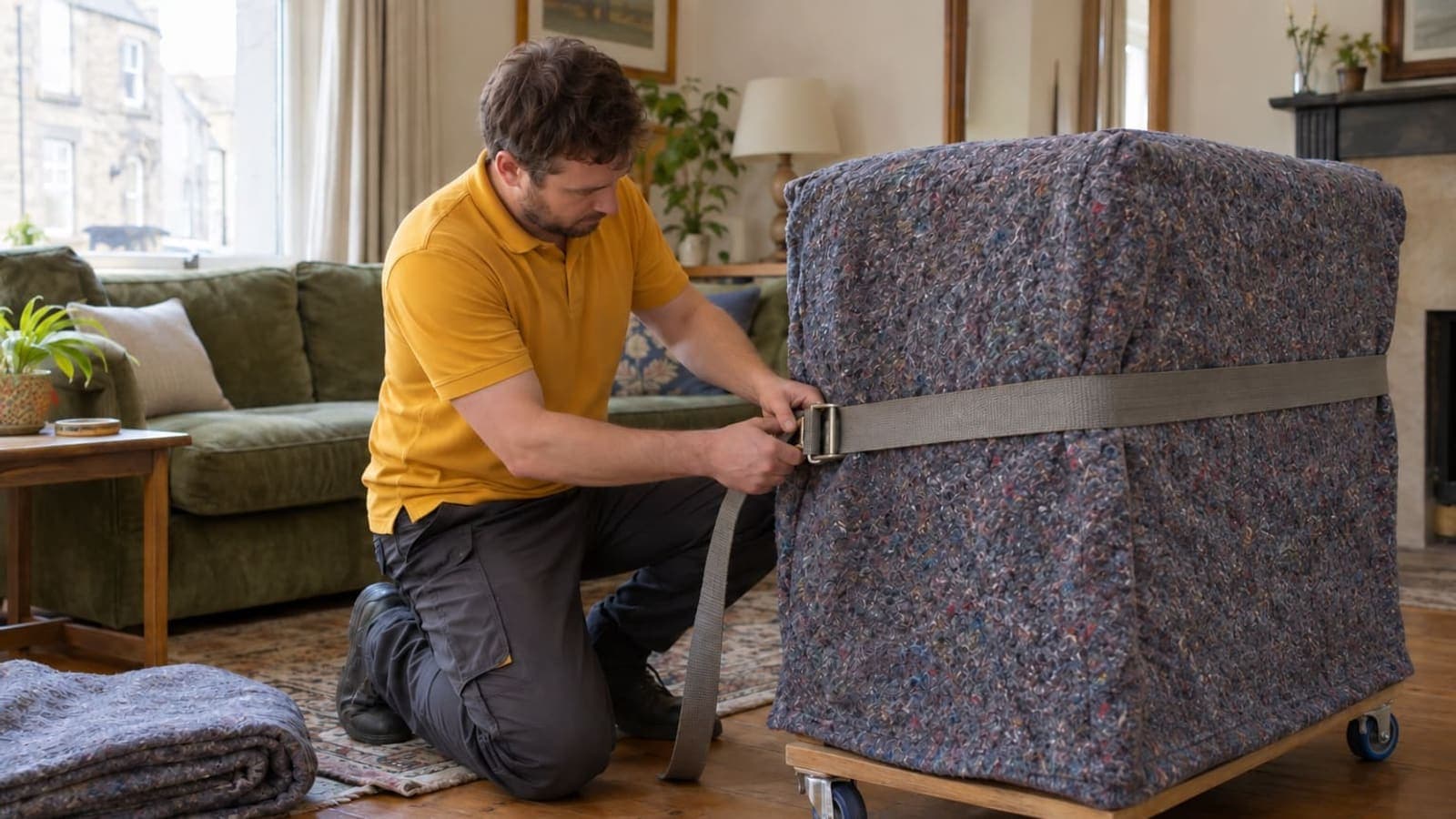
Every few weeks someone asks whether we can "just pop a piano in the van with the rest". We can, but there is nothing "just" about it. A piano is the heaviest, most awkward and most valuable single item most households will ever move, and in Glasgow it usually has to come down a tenement close first.
Here is how a piano move actually works, what kit is involved, what it costs as a guide, and the handful of things you should never do.
What kind of piano are you moving?
The first question is always upright or grand, because they are moved completely differently.
Upright pianos are the ones most Glasgow homes have, often inherited and often older than the flat. A modern upright weighs roughly 150 to 250 kg. Older uprights with a full cast-iron frame can be heavier still, and they are usually the ones living two up in a red sandstone close. Uprights move standing up, on their own castors only for the last few inches, strapped to a board or a trolley for everything else.
Grand and baby grand pianos are a different job. A baby grand is typically 250 to 350 kg and a full grand considerably more. A grand does not move on its legs. The legs and the pedal lyre come off, the body is tipped onto its long flat side on a padded skid board, wrapped, and moved like a very heavy, very precious wardrobe.
Why do tenement stairs make piano moves harder?
Weight on the flat is one thing. Weight on stairs is another. A piano going down a tenement close is a controlled slide with several hundred kilograms wanting to go faster than you do, and the half-landing turn is where it all gets decided.
- The turn. Most Victorian closes have a half-landing where the stair doubles back. An upright has to be tilted, swung and settled on the landing, then lined up for the next flight. The landing depth and the stair width set what is possible.
- Headroom. Low windows and dropped ceilings on the turn limit how far the piano can be tilted.
- The close door and storm door. Usually fine for an upright, occasionally tight for a wide older model.
- Steps at the front. Main-door flats in the Southside and West End often have a short flight of external steps, which needs a ramp or a careful lift.
- Floors. Ground floor is a straightforward job. Three up is a serious one, and the price reflects it.
Tell us the floor, send a photo of the stair, and we will say honestly whether it is a two-person or three-person job. Our tenement flat removals page covers how we protect the close and the neighbours' walls.
What equipment do piano movers use?
Nobody carries a piano the way you carry a sofa. The kit does the carrying; the movers do the steering.
- Piano board, or skid. A padded plank the piano is strapped to, so the weight is spread and the piano can be slid rather than lifted.
- Straps. Heavy ratchet or cam straps that hold the piano to the board and give the crew handles that will not slip.
- Moving blankets. Several layers, taped, to protect the case and the close.
- Stair-climbing trolley. For uprights on stairs we use a stair climber, which takes the piano one step at a time with the weight under control rather than in somebody's arms.
- Piano dolly. For the flat run from the door to the van, so the piano's own castors are never asked to cross a threshold.
- Tail lift or ramp. Into the van, where it is strapped to the side, upright, with nothing stacked against it.
How many movers does it take to move a piano?
- An upright on the ground floor, flat access, van outside: two experienced movers with the right kit.
- An upright down one or more flights of a tenement: three. One below steering, one above controlling the descent, one spotting the turn and managing the door.
- A grand of any size: three or four, plus the time to dismantle and wrap it properly.
The number is about control, not strength. A piano on stairs with too few people is where injuries and damaged instruments happen.
How much does it cost to move a piano in Glasgow?
These are guide prices only. Every piano move is quoted on the piano, the floors and the distance.
| Job | Guide price |
|---|---|
| Upright added to a house or flat removal we are already doing | From about £120 |
| Upright on its own, within Glasgow, ground floor to ground floor | £180 to £250 |
| Upright involving tenement stairs at one or both ends | Add for each flight, quoted on the stair |
| Grand or baby grand | Priced on inspection or a detailed video |
Stairs, long carries, awkward turns and anything outside the city push the price up. If the piano is part of a bigger house removal, bundling it in is the cheapest way to do it. Our removal costs guide explains how we build a price.
Is a piano move insured?
Ask any mover this before you book, including us. The things to check:
- That the company carries goods in transit cover, and what the limit per item is.
- That you have declared the piano and its approximate value, so it is not treated as ordinary household goods.
- Whether cover applies on the stairs and in the home, not just in the van.
- That the figure is in writing on your quote.
We note any existing marks on the case before we start, and we will tell you honestly if a piano looks too fragile to move safely.
Should a piano be tuned after a move?
Yes, but not straight away. Moving a piano does not usually knock it out of tune by itself; the change in temperature and humidity in the new room does. Give it two to four weeks to settle, then have it tuned. In the meantime, keep it away from radiators, out of direct sunlight, and if possible off an exterior wall in a draughty older flat.
What should you never do when moving a piano?
- Never lay it on its back. The action and the soundboard are not built for it.
- Never lift by the legs. The legs on a grand and the castors on an upright are not handles. They snap.
- Never attempt it with two friends and goodwill. No kit, no straps and a tenement stair is the classic way to end up with a broken piano and a broken ankle.
- Never roll it on its own castors across thresholds or over close tiles. They were designed for a quarter-turn on a carpet.
- Never dismantle a grand yourself. The legs and lyre come off in a particular order with the body supported throughout.
Frequently asked questions
Can a piano go in a man and van?
An upright on the flat can, with the right crew and kit. We do not do pianos as part of a standard single-mover man and van booking because it needs at least two people and a board.
Can you move a piano up to a third-floor tenement flat?
Usually, as long as the stair turn allows it. Send a photo of the close and the piano and we will tell you straight. Very occasionally the honest answer is that it will not go, and it is far better to know before the day.
Do I need to empty or lock the piano?
Take anything off the top and out of the stool. Lock the keyboard lid if it has a key, and we will tape the lid of a grand once it is wrapped. We handle the rest.
Got a piano to move?
Request a quote with a photo of the piano and the stairs at both ends, or call Peter on 07481 469221 and we will tell you what it needs and what it will cost.
Was this guide useful?

Next in your journey · Planning
How Much Notice Does a Removal Company Need in Glasgow?
Ready to get moving?
Send your move details and Peter will come back with a clear, honest quote. No obligation, no pushy follow-ups.